Automated Water Filtration System
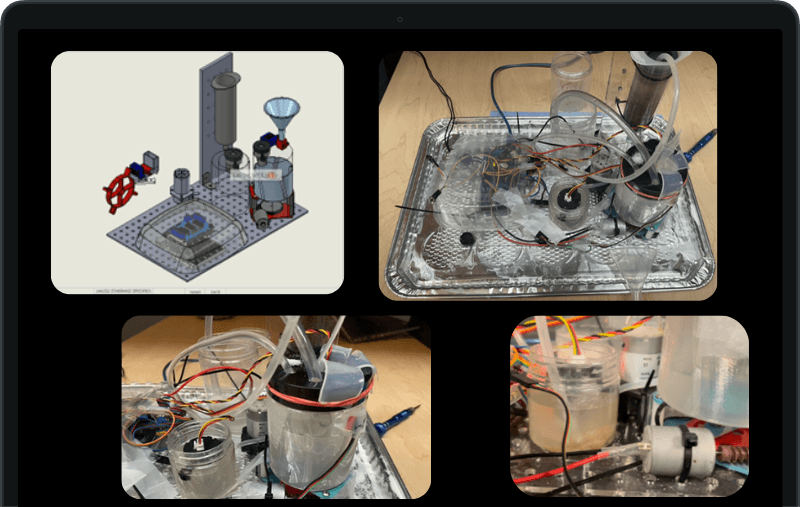
Leading a five-person team to design and prototype an automated filtration system for a remote Nunavut community scenario, with a custom alum dispenser and closed-loop control in C++.
The problem
APSC 101 is Queen's first-year engineering design course, built around a realistic client scenario. Ours: a remote Nunavut community that needs clean drinking water, where skilled maintenance is hard to come by and supplies arrive infrequently.
That shaped the brief. The system had to run with minimal human intervention, dose treatment chemicals reliably, and shut down safely if anything went wrong.
My role
- Team lead for five people: split the work into subsystems, set milestones, and kept design decisions aligned.
- Designed the alum dispensing subsystem in SolidWorks.
- Wrote the C++ control logic tying the pumps, water-level sensors, motors, and emergency stop together.
How it works
Coagulation with alum. Raw water carries tiny suspended particles that are too small to filter easily. Adding a measured dose of alum makes them clump into larger flocs, which settle and filter out far more effectively. The dispenser I designed meters that dose automatically.
Closed-loop control. Rather than running pumps on fixed timers, the controller reads the water-level sensors and switches pumps and motors in response, so the system adjusts to what's actually happening in each tank. An emergency stop overrides everything and cuts all actuators immediately.
Process
- 1
Understand the client
Researched the community scenario to pin down requirements: automation, reliability, safety, and simple upkeep. - 2
Design the subsystems
Split the system into treatment, pumping, sensing, and control, and modelled the alum dispenser in SolidWorks. - 3
Build & program
Assembled the prototype and wrote the C++ control logic for the pumps, level sensors, motors, and e-stop. - 4
Test & iterate
Ran documented experiments, collected and analyzed data, and refined the design until the system filtered water as intended.
Outcome
The prototype successfully filtered water as designed. Every test was documented with clear, reproducible procedures, so another team could rerun our experiments and get the same results.
What I learned
- Leading a team means making decisions early and communicating them clearly, so five people build parts that actually fit together.
- Designing for a real user (here, a remote community) changes priorities: reliability and safety beat cleverness.
- Good documentation is part of engineering, not paperwork after it.